.png)
Giving Them Something Worth Staring At
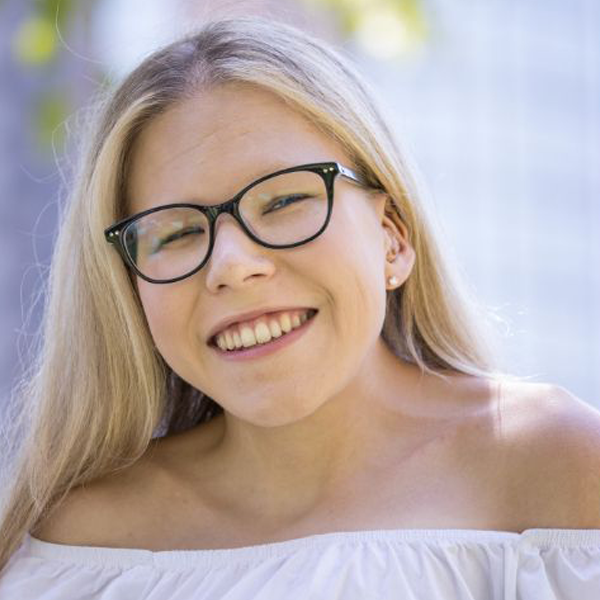
I used to try to hide my disabilities. I know this might sound silly coming from someone who looks very obviously physically disabled, but it’s true. Despite my family’s best efforts, growing up in a society built on the pillars of ableism and eugenics meant that from a very young age, I was taught by others outside of my family unit that disability was a bad thing. Unfortunately, because my disabilities are so apparent, I didn’t have many options for how to physically hide them.
In case you haven’t seen me in the flesh, let me paint the picture for you. I have a form of dwarfism, so at 23-years-old, I stand at about four feet and three inches tall. I have kyphoscoliosis, so not only do I have a prominence, or a hump, on my back, but I also lean slightly to the right, thanks to the scoliosis. I have a five inch difference between my legs so I wear a foot-on-foot orthotic prosthesis to compensate for the discrepancy. My torso is very short and my arms and legs are very long. My hands and feet are a bit too big for my petite frame, and I wear glasses and hearing aids. So you can only imagine how I looked as a child.
Before I started wearing my first prosthesis, I wore a lift on my shoe from ages four to seven to help me walk. I became really self-conscious of people of all ages staring at me when I went out in public.When I noticed someone gawking at me, I would try with all of my might to hide my shoe with the lift behind my other leg. Not only was this uncomfortable, but I don’t think it actually made a difference in whether people stared at me or not. If anything, I’m sure it probably caused them to stare more. I also tried hiding myself altogether. Whether it was behind my mom, a shopping cart, or a rack of clothes, it didn’t really matter. The goal was to, at least partially, escape from the prying eyes. I quickly discovered that trying to completely conceal myself into a rack of sweatshirts didn’t work because once my mom ultimately realized her young, medically complex child disappeared out of thin air, it didn’t end very well.
Not only was I insecure about the unwanted attention I seemed to attract from strangers, but my family also quickly became fed up with the way I was treated by the general public. While my grandma tried to turn other kids’ stares into a teaching moment by asking if they had any questions, my younger sister took a very different approach. Three and a half years younger than me, she’d catch a stranger staring and immediately turned into a small, human siren, pointing and yelling, “WEE WOO, WEE WOO, STARING POLICE!” as she very loudly mimicked the sound of a police car. She mainly did this because she was very protective of me, but also because it made me laugh.
Even though some of these awkward moments ended in me and my sister laughing hysterically, they always left me feeling insecure. People were gaping at me because I was different. And on some level, I didn’t want to be.
When I was 13, I went in for a 52 day stay at Seattle Children’s Hospital where I underwent halo traction, several unplanned emergency surgeries, and finally, a full spinal fusion. Because of the halo, I ended up making the decision to chop all my hair off, which is not a fun choice to make for anyone, much less a young teen. I only did it because it’s very difficult to wash long hair when eight metal pins are screwed into your skull.
When my mom saw how upset I was about cutting my hair and the fact that I was totally out of control of my own body and what happened to it, she promised me something that I had been waiting for my entire life. She told me that once my halo came off and my pin sites were fully healed,that I could dye my hair any color I wanted. And just as she promised, once the holes in my head had fully healed, my 13-year-old dreams came true.
After I was discharged from my extended hospital stay, not only did I have fresh wounds healing all over my body, I now wore a prosthesis that made me look like I had three feet, was in a manual wheelchair most of the time, and had to wear a back brace for three months to make sure my spine didn’t collapse. If people’s eyes weren’t glued to me out in public before, they sure were going to be now.
While I pretended to have all of the confidence in the world to mask how I was really feeling about these new circumstances I was forced to grow accustomed to, I was definitely struggling. On top of everything I was dealing with physically, I still had the normal early teen feelings of wanting to blend in with my peers. I had no desire to stand out, but I didn’t have a choice.
I remember talking to my grandma about how self conscious I was feeling. She was the one who suggested I dye my hair a fun color instead of something more “natural”. I was opposed to it at first. Why would I give people another reason to stare at me?
“Think about it this way,” she said. “If you go out in public with all your stuff going on, but you also have purple hair…they’re not going to know where to look. People are already going to stare. So why not give them something worth staring at?”
I didn’t realize it then, but that was the first time I learned I could choose how I showed up in the world. If people were going to look anyway, I didn’t have to make myself smaller to make it easier for them. Hiding only fed into the harmful idea that disability is something shameful. And I was done feeling ashamed of the things that made me me.
Sometimes choosing how I show up looks like purple hair, sparkly shoes, or a fun sweater. Not to distract from my disabilities, but to remind myself that being visible doesn’t have to mean being diminished. The truth is, people are always going to stare. The dare was deciding not to disappear because of it.
Cassidy Huff is a nationally recognized disability rights advocate, writer, and content creator. As a physically disabled and hard of hearing woman, she brings a unique perspective to her work, centering equity, accessibility, and authentic representation. Cassidy is a best-selling author, public speaker, and the host of a podcast focused on amplifying disabled voices and lived experiences. Her advocacy spans across digital media, education, and entertainment, and her work has been featured in national campaigns and conversations around disability rights. In addition to writing, Cassidy is the director and producer of two original web series highlighting adaptive adventures and the disability community. She uses her platform to inform, empower, and shift narratives—whether through writing, long-form, short-form content, or public speaking.
Lorem ipsum dolor sit amet, consectetur adipiscing elit. Suspendisse varius enim in eros elementum tristique. Duis cursus, mi quis viverra ornare, eros dolor interdum nulla, ut commodo diam libero vitae erat. Aenean faucibus nibh et justo cursus id rutrum lorem imperdiet. Nunc ut sem vitae risus tristique posuere.
Lorem ipsum dolor sit amet, consectetur adipiscing elit. Suspendisse varius enim in eros elementum tristique. Duis cursus, mi quis viverra ornare, eros dolor interdum nulla, ut commodo diam libero vitae erat. Aenean faucibus nibh et justo cursus id rutrum lorem imperdiet. Nunc ut sem vitae risus tristique posuere.